Showing posts with label hamilton. Show all posts

Monday, June 24, 2019

Spring House Gazebo in Eden Park - Cincinnati

Written by Dani and Andrew Livelsberger
Photography by Andrew Livelsberger


Background:

This Moorish styled Gazebo is within eye sight of Mirror Lake, both of which are located within Eden Park.

The gazebo was designed and construction completed in 1904, making it the oldest enduring structure in the Cincinnati park system.

The Spring House Gazebo is also famous for the Remus Incident.
The Remus Incident in a nutshell is that a Cincinnati lawyer and bootlegger, George Remus went to jail and while there he unknowingly told an undercover prohibition agent posing as an inmate that his wife, Imogene controlled all of his money.

The undercover agent named Franklin Dodge resigned his position and started a relationship with Imogene Remus.  Together, they basically took all of George Remus' money, tried to have him deported and also hired a hit man to kill him for $15,000.

When Imogene finally decided to file for divorce, that was the last straw for George Remus.   On his way to the divorce proceedings, Remus had his driver follow and run Imogene's car off the road by Spring House Gazebo.   George Remus exited his car and fatally shot Imogene.

Legend has it that one certain nights, the ghost of Imogene can be seen looking of the gazebo over Mirror Lake.


Impression:

Spring House Gazebo is a beautiful structure and catches your eye as soon as you turn the corner of the road.

If you turn left, there is parking and restrooms just a short walk away.

You have a beautiful view of Mirror Lake and the fountain can be seen off to the left.

This is a popular spot for people to stop and rest while walking between hiking trails.  Eden Park is a great place to visit and stopping by Spring House Gazebo should be a must stop as it is a central hub to other sections of the park.

It also seems to be a popular stop for those who like to play Pokemon Go!


Monday, April 1, 2019

Cincinnati / Over The Rhine Street Art

Written by Dani and Andrew Livelsberger
Photography by Andrew Livelsberger


Background:

The revitalization of Cincinnati's Over The Rhine area abounds with must see street artworks.


Impression:

If you do any internet searches on the Over The Rhine area of Cincinnati, you may be surprised by what you read.   Just a few years ago, it was one of the most densely populated city areas in the country.   Articles about the crime rates were the norm.

Through many efforts by the city, community organizations, and enduring residence, the Over The Rhine area has come a long way.   Vine Street is now bustling with retail gems, barber shops, and culinary delights.


This area has changed.  It has changed a lot.  While I would never presume to say that any area is crime free or any inner city area is 100% safe, you can definitely tell that this area has made huge strides to reduce crime and blight.

If you are around the Vine and 12th Street area, you are close to Washington Park and the Cincinnati Music Hall.

Findlay Market, having its own storied history, is within walking distance of the hustle and bustle of Vine and 13th.

Staying in an AirBnB in the heart of Over The Rhine gave use the opportunity to take in the neighborhood.


While the renovations and legacy architecture stand out to you, what popped out at us more so than anything else is the mural and street art you see almost everywhere. 

Having worked professionally with some local Columbus mural projects, we have a decent idea of what it takes to pull these projects together.   We also understand the pride, beauty and hope that these artworks provide to the community.   This is not only for those from the neighborhood, but is an excellent draw for those coming into the area for the first time or frequent visitors. 

Art like this makes people want to walk around and discover it, thus giving business more potential for walk by traffic.


Art on display is not of one type either.  Various artists and styles are employed.  You also have commissioned work as well as what appears to be graffiti-type work on vinyl.

This level of artwork is incredible and we feel, improves the panache and draw to the area.


We are looking forward to returning to this area to do some in depth about this great community.   Keep checking back or subscribe to our RSS feed to stay in the loop!

Thursday, January 3, 2019

Cincinnati Museum Center - Guitar Exhibit

Written by Dani and Andrew Livelsberger
Photography by Andrew Livelsberger


Background:

The Cincinnati Museum Center Guitar exhibit not only showcases various guitars but also explores the science of sound.

Impression:

While we are definitely fans of music, we often do not take the time to look at the instruments that make it possible.

The guitar has been with use for a long time and has gone through many iterations of change.   Going from a primitive wooden box with a hole and strings on it to expertly crafted acoustic and thanks to people like Les Paul - electronically amplified versions.


The Cincinnati Museum Center's exhibit, Guitar shows the progression of this evolution.  Not only of the instrument itself, but you'll also have the opportunity to learn the science behind sound as it relates to music and the featured instruments here.


One of the greatest guitarists and musical pioneers, B.B. King has his famous guitar "Lucille" on display here.    I also saw that Tony Iommi of Black Sabbath fame had a guitar featured here.

The world's largest guitar is also here on display.  A Fender Stratocaster of 43 feet is just inside the exhibit room and to your right.  It was so big that I honestly didn't realize what it was at first.  I thought it was just a large display for information placards.


The Air Guitar area was both funny and fantastic.   I thought it was a great addition to the displays.   It is truly the best sounding guitar that is affordable to and playable by all.


I do not know of one person that does not like music.  Even if you have a passing interest in the instrumentation that creates a large portion of music through out history, this is a great exhibit to check out.  This exhibit is even good for kids, as there are some hands on areas where you can design your own guitar or see the physics of how guitar strings vibrate.

Just note that at the time of this writing, the Cincinnati Museum Center is still undergoing a large renovation.  The other larger museum areas are closed and the only areas open are the kids museum and the Guitar and Chocolate exhibits.

Monday, November 5, 2018

Church of the Immaculata Atop Mt. Adams - Visual Ohio One Shot!

Written/Photography by Andrew Livelsberger


Location:  30 Guido St, Cincinnati, OH 45202

This church was built in 1859.   In short, the story goes that Archbishop John Baptist Purcell was on a boat at sea during a severe storm.  He prayed to God that if they were to make it back to shore safely, he would build a church at the highest point in Cincinnati.

We wanted to do this one shot to get this great building on your radar, but know that we intent to return to the church and get some additional images and do a full Visual Ohio feature on it.   Not sure exactly when that will be.

Monday, October 29, 2018

Scarecrow Row

Written by Dani and Andrew Livelsberger
Photography by Andrew Livelsberger


Background:

Local individuals, businesses, and organizations show their creativity by crafting custom scarecrows in Otto Armleder Park on the east side of Cincinnati.  In 2018, the scarecrows at Scarecrow Row are on display from September 30 to October 14.

Impression:

Scattered along the main walking paths and picnic areas of Otto Armleder Park, Scarecrow Row is a display of artistry from a farmer's tradition.

Walking along the path's some scarecrow displays are made from hay while others chose to use corn stalks and husks. 

Each one has a different theme.  Some, as seen above in "serenity" espouse a sense of calm and peace, while others like Frankenstein's Monster and Bride of Frankenstein harken us back to classic horror film characters.


Others are more modern, showing arts and diversity.


While this season's Scarecrow Row is coming to a close, look to the parks calendars for next year - hopefully you'll be able to get to Otto Armleder Park next year and they do this again.


Monday, October 22, 2018

Spring Grove Cemetery

Written by Dani and Andrew Livelsberger
Photography by Andrew Livelsberger


Background:

A full history from the Spring Grove Cemetery and Arboretum can be found HERE.

Having a need to handle the internment needs of the city during the 1830/1840 cholera epidemics, city professional leaders and the Cincinnati Horticultural Society formed a cemetery association in 1844.

The goal was to find a place for a cemetery that was big enough to handle the needs of the city, but not be infringed upon by expansion. In addition, the association wanted it to handle funeral needs as well as house many kinds of plants, trees, and flowers.  The members traveled all over the United States and Europe for inspiration and ideas.

Over its 150 year history, the Spring Grove Cemetery has been a leader in cemetery design.

Impression:

When you first enter into the cemetery grounds, you realize you are in some place special.  The architecture and layout definitely hit the mark on what the original founders and designers wanted to do.

Old world architecture in the buildings, art deco designs and more modern flow together seamlessly.  The paths and roads wind you about into different areas and there seems to be something awesome to see at every turn.


This is an area that I think you could visit for months and years and be able to find something new and interesting.  Not only that, but the look and feel of the area could change even based on the seasons!

Walking about, we saw signs that showed community activities are even held here.

Some of you might be thinking that a cemetery is an odd place for community events.  However, remember that this cemetery was built with this kind of thing in mind.   We can still give respect to those interned here and serve the community by using the space.  Also, having the resources of the community will provide additional funds to help maintain the space.


Looking at the headstones, you'll notice that there are large varieties here.  More so than I think I've ever seen at any other cemetery.
There are your more modern monolith shapes, Washington Monument shaped obelisks, and flat to the ground stones and plates.

I think this makes the more unique markers and stones stand out.  There are ones with multiple tiers, built up shapes, busts and the like.


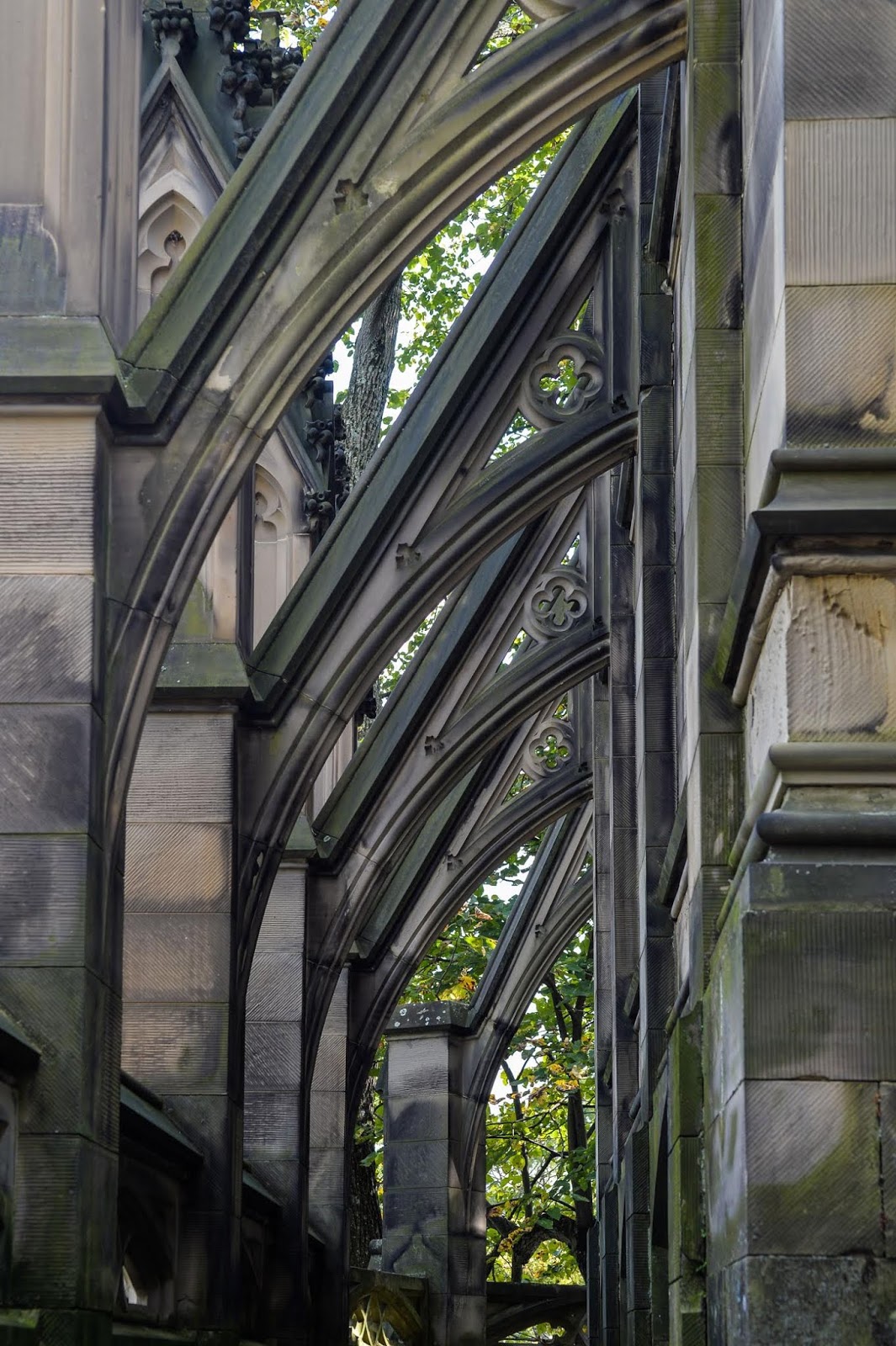
You also have various types of mausoleums and church structures.  As seen below, these structures are large, beautifully built.  From afar they have one kind of beauty, but then looking closer at the details, you'll see the inspired architecture that went into these buildings.   A great example of this is the building below, we lovingly nicknamed "Goth Building". 

The first image is the front from afar, then the next image that follows is the details in the arches that are on either side of the main doors.


Then we can pull further back and see these fantastic views with large beautiful buildings in the background.


Maybe we are weird, but there is a beauty and serenity in places of internment.  Spring Grove Cemetery makes that even more so by not just being a place of internment, or of final rest.  No, the designers decided to make this a place that is part of the community.  It is a place where the lives of those that came before us can be celebrated.  We remember them not only by the names on the stones, but also by making the cemetery space a viable, useful area for those still wandering the surface.

So, next time you think about a place to go and just be - think about visiting and learning about the souls that are here at their final rest.